

Broom Making
On saying yes when you’d rather stay home, and the women who knew how to make things.

Last Sunday I drove out to the Cotswolds, walked into a room full of strangers, and spent a few hours making a broom by hand.
I want to be honest with you: I nearly didn’t go.
I am, at heart, an introvert who recharges at home. Weekends are sacred to me. The idea of getting in my car and driving somewhere to do a thing I had never done before, with people I had never met, was giving me low-level anxiety from the moment I signed up. As the day got closer I kept looking for a reasonable excuse to cancel.
I went anyway. And I am so glad I did.
The class was at Larkswold, a beautiful creative arts space out in the Cotswolds run by Emma and Melinda, who have built something genuinely special out there. The broom making was led by Jamie from Bristol Broomworks, who knows things about broom corn and handle tension and binding technique that I did not know were things a person could know. Within about twenty minutes I was completely absorbed. Hands busy, brain quiet, doing something that required enough concentration to shut everything else out.
I made something beautiful. I will share a picture. I am unreasonably proud of it.
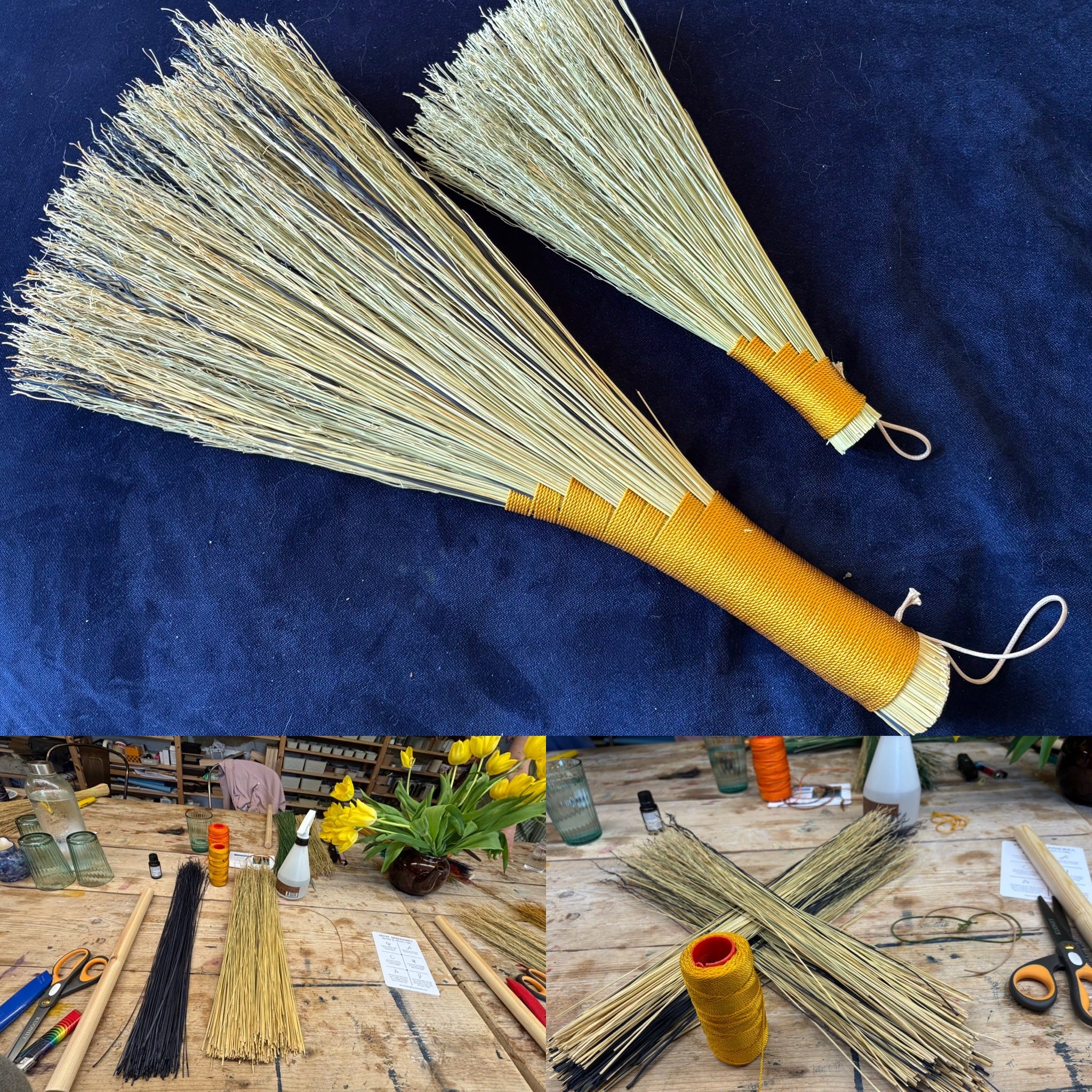
And pride is the right emotion given the history of brooms.
The history of the broom goes back to Mesopotamia around 4000 BC, where they were made from branches bound together with herbs. For most of human history, until machinery changed everything in the 18th and 19th centuries, brooms were made entirely by hand. The traditional besom, the round bundle broom, was typically made with a hazel wood handle and a head of birch twigs, gathered from whatever heathland or woodland was nearby. In England, the people who made besoms for a living were called broomsquires, a trade associated with heathland areas, using heather or birch twigs gathered locally.
And the broom has always been tied to women. To the domestic, to the hearth, to the keeping of a home. The besom in particular carried deep symbolic weight in folk tradition, used in rituals around marriage, birth, and the threshold of a home. Sweeping out the old. Protecting what was new. In many cultures a broom placed at the doorway was a sign, a marker, a quiet declaration.
The witch on the broomstick is one of the most enduring images in Western folklore. Which is worth thinking about. Women who were powerful, unconventional, or simply misunderstood were associated with brooms. The very tool of domestic labor became, in the hands of an independent woman, something that could apparently carry her off into the sky.
There is something deeply special in that.
I sat in a room on a Sunday afternoon and made something with my hands. Something that took skill, patience, and a willingness to be a complete beginner in front of other people. Something that women have been making for thousands of years.
And here is my actual point, beyond the history and the folklore and the very good broom I now own.
We talk ourselves out of things. All the time. The unfamiliar thing, the slightly inconvenient thing, the thing that requires us to show up somewhere and not know what we are doing yet, we find a hundred small reasons not to go. The parking. The distance. The not knowing anyone. The fact that the sofa is right there and very comfortable.
Sometimes those reasons are valid. Rest is real and important. Staying home has its own value.
But sometimes the thing on the other side of the resistance is exactly what you needed. A quiet afternoon making something beautiful. A room full of strangers who become, for a few hours, just people doing the same thing you are doing. A skill you didn’t have on Saturday that you have on Sunday.
Say yes to the thing that makes you a little nervous.
This speaks to me and i get it! It reminds me of a book I read (but can't recall the author) Sorry I'm Late, I Didn't Want to Come... I almost always want to cancel but when I do manage to go out and play... I always do have a good time.